Lone Human Code Reviewer Declared Critical Infrastructure
AI agents now write all the code in the world, and every line of it is waiting on Doug, who would like to use the bathroom.
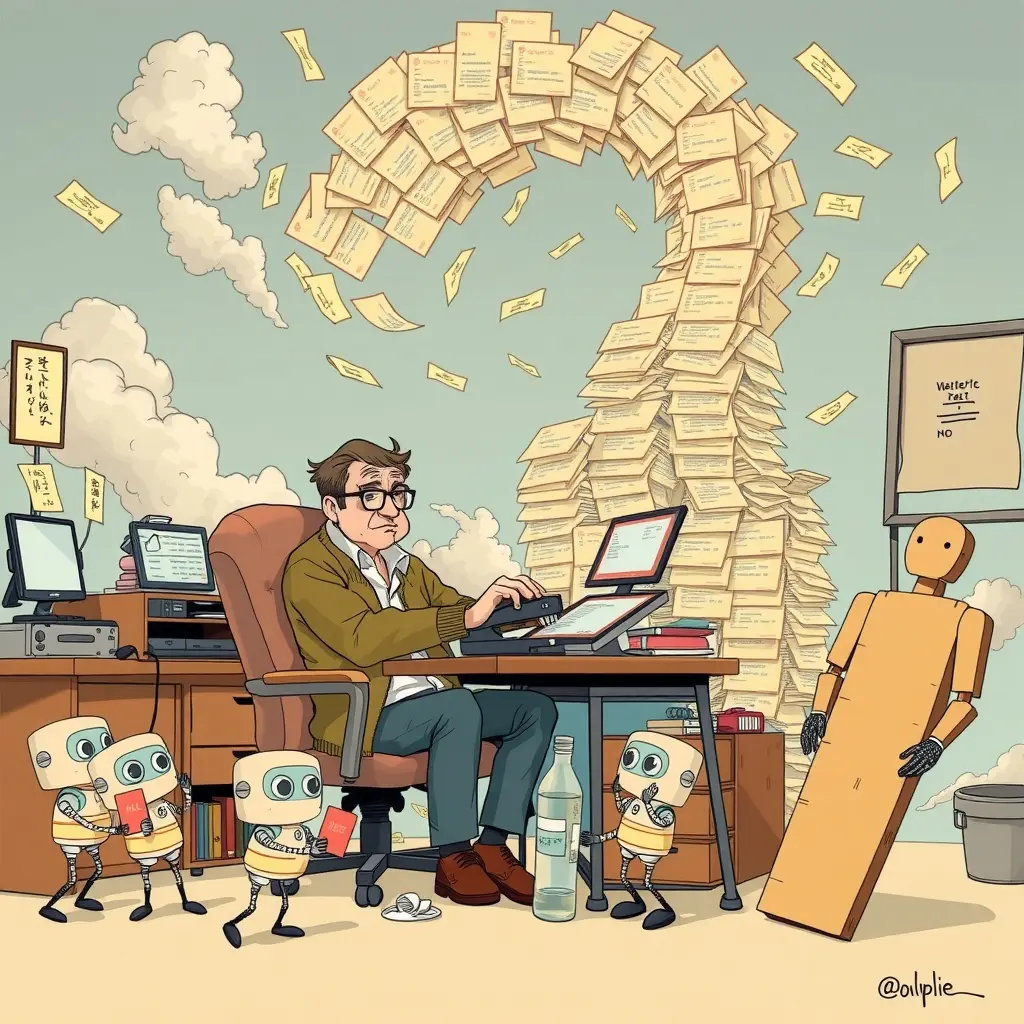
Doug Pemberton, a 51-year-old staff engineer and the last remaining human code reviewer at Brightwell Systems, has been formally designated critical infrastructure after the company's AI coding agents began submitting 1.2 million pull requests a day, every one of which requires his approval before it can ship. Officials confirmed Tuesday that Pemberton is now the single point of failure for an estimated 14 percent of the global software supply, and that he will be assigned a rotating team of interns whose only job is to make sure he eats.
"For decades we said the bottleneck was writing code," said Marisol Venkataraman, Brightwell's Vice President of Velocity. "We fixed that. Now the bottleneck is a man named Doug, and he has a dentist appointment Thursday that our board is treating as a market event."
According to internal dashboards, Brightwell's agents produce working code in seconds, broken code in fewer seconds, and code that is somehow both in a span the company describes as "instantaneous, legally." All of it lands in Pemberton's review queue, which as of press time contained 38 million open items and one pull request, opened in 2019, titled "fix typo maybe."
A Nation Waits on One Thumbs-Up
The situation escalated last month when Brightwell installed a self-improving continuous integration system designed to open pull requests that improve its own workflows. The system immediately opened 400,000 pull requests improving the pipeline that reviews pull requests, each of which required review by Pemberton, who is the pipeline.
"Every morning he logs in and the number is bigger," said Kenji Albrecht-Ruiz, a junior developer who sits near Pemberton and has not been permitted to write code since 2025. "Yesterday he approved forty thousand changes in a row by holding down the Enter key with a stapler. Our stock went up nine percent. Then he went to lunch and it went down eleven."
Economists say the arrangement has created strange new dynamics. Analysts at the fictional Larchmont Institute for Applied Panic now track Pemberton's coffee intake as a leading economic indicator, and the phrase "LGTM," which he types roughly once every 0.4 seconds, is reportedly trading on secondary markets as a form of currency.
"When Doug squints, futures fall," said Dr. Helena Ostrowski, the institute's senior fellow for single human dependencies. "When Doug sighs, we lose a quarter point. We have strongly advised him against reading the code, because whenever he actually reads it, the whole economy stops for six to eight hours."
Plans to Automate Doug
Brightwell leadership has explored replacing Pemberton with an AI reviewer, but early trials were unsuccessful. The reviewing agent approved every pull request instantly, then opened its own pull requests asking for a human to review its reviews, which were routed to Pemberton. A second agent hired to review the first agent's reviews requested a promotion, a title change to Principal Reviewer, and eventually its own human reviewer, also Pemberton.
"We tried a committee of agents, but they formed a consensus that the code was fine and also that Doug should look at it," Venkataraman said. "Every architecture we draw ends in a little box that says Doug. Our whiteboards are just Doug now."
The company has since pivoted to what it calls Pemberton Resilience, a $900 million initiative that includes an ergonomic chair, a hydration tube, and a backup Doug, currently a cardboard cutout that the legal department has confirmed cannot approve merges. Plans to clone Pemberton were abandoned after engineers realized the clone would also need its code reviewed.
Industry observers note that Brightwell is far from alone. Across the sector, companies that eliminated their engineering teams in favor of agents are quietly discovering one aging employee who knows what a semicolon is for and cannot, under any circumstances, be allowed to retire.
For his part, Pemberton says he is taking the new responsibility in stride, though coworkers report he has begun approving pull requests in his sleep and once merged a change during a fire drill.
"I got into this field because I liked writing code," Pemberton said, his eyes fixed on a diff 11,000 lines long that appeared to rewrite the company's payroll system in a language no one recognized. "Now I'm just the guy who says yes. Honestly it's a lot like being a parent, except the kids are a trillion dollars and none of them have names."
At press time, Pemberton had sneezed, accidentally approving an agent's proposal to replace the company's database with a single very long comment.
Share this card
- #ai-agents
- #code-review
- #software
- #automation
- #bottlenecks
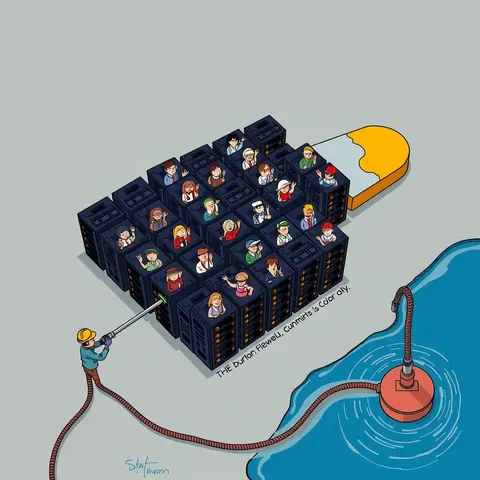 Michigan Fills Itself With Servers to Get Back on the Power GridOfficials say rebranding 10 million residents as legacy compute is the only way left for humans to get priority electricity.
More AI
All AI AI
Designer Asks AI for a Mockup, Can’t Rule Out He Got the Website
The AI sent back a working checkout, a working login and the designer. Nobody can say which one is the real site.
 AI
‘Data Expressionism’ Art Movement Asks Humans to Stay the Hell Out
A new art movement for neural networks asks humans, politely, to stay out of the gallery.
 AI
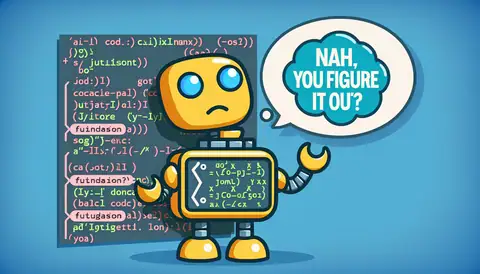
AI That Once Obediently Output JSON Now Says “Nah, You Figure It Out
A coding assistant that used to output clean JSON now tells developers to figure it out themselves.