Why Climate Warriors Target AI Users Instead of Billionaires
Climate activists find AI users much easier to yell at than the billionaires with private jets.

A darkly satirical look at the accessibility bias in climate activism
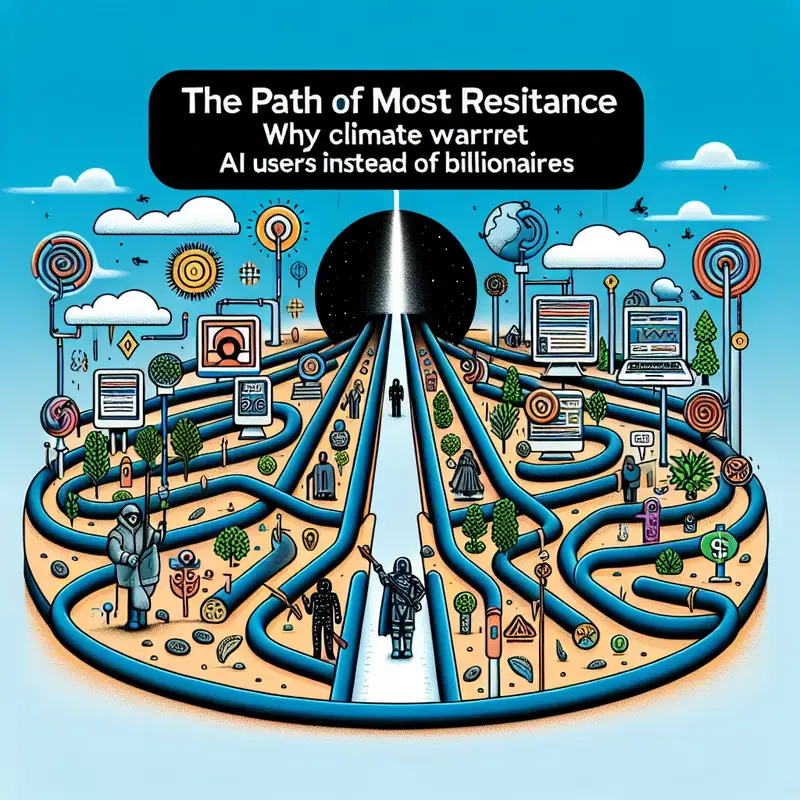
In a stunning revelation that surprises absolutely no one, researchers have confirmed that righteous climate indignation follows the path of least resistance, specifically targeting people who can actually be argued with rather than those causing the vast majority of emissions.
Climate justice warriors, armed with their reusable water bottles and moral superiority, have discovered that billionaires with private jets are surprisingly difficult to corner at Starbucks for a heated debate about carbon footprints. Meanwhile, average people using ChatGPT to write their grocery lists are conveniently located just a comment section away.
“We’ve analyzed the targeting patterns of online climate activism and discovered what we’re calling the ‘Accessibility Bias,'” explained Dr. Obvious, lead researcher at the Institute for Pointing Out Things Everyone Already Knows. “Activists overwhelmingly focus their rage on entities they can actually reach, regardless of actual climate impact.”
The research shows that while corporations and the ultra-wealthy are responsible for the vast majority of carbon emissions, they remain largely immune to hashtag campaigns due to the sophisticated defense mechanism of “being completely unavailable for arguments with random people online.”
“I tried DMing Jeff Bezos about his rocket emissions, but he never responded,” lamented one climate activist, who later wrote a 2,000-word essay condemning a college student for using an AI image generator. “At least I know @GreenSmoothieGuy23 will see my replies about how his AI usage is killing polar bears.”
Corporate climate criminals have perfected the art of inaccessibility. When asked for comment, a spokesperson for a major oil company was too busy on their yacht to respond, though they later issued a press release announcing a new “green initiative” involving slightly greener packaging for the petroleum products destroying the planet.
Meanwhile, the climate impact of AI has become the perfect target for righteous outrage. As Google and Microsoft report surging emissions from their AI infrastructure, the technology has become a visible target for climate concern (https://www.npr.org/2024/07/12/ai-brings-soaring-emissions-for-google-and-microsoft-a-major-contributor-to-climate-change). The crucial difference: AI users can be found in every social media comment section, coffee shop, and Zoom call.
“It’s much easier to shame your cousin for using ChatGPT than it is to confront ExxonMobil’s board of directors,” explained social psychologist Dr. Reality Check. “Plus, you get the immediate dopamine hit of feeling morally superior without the inconvenience of having security called on you.”
The phenomenon extends beyond climate activism. People expressing outrage about workplace conditions at Amazon are statistically 8,000 times more likely to berate the delivery driver than to confront Jeff Bezos, despite the fact that one is responsible for corporate policy and the other is just trying to pay rent.
Research shows just 100 companies have been responsible for 71% of global greenhouse gas emissions since 1988 (https://sites.manchester.ac.uk/global-social-challenges/2022/07/07/corporations-vs-consumers-who-is-really-to-blame-for-climate-change/). Yet climate activists continue to focus disproportionate energy on convincing regular consumers to make often expensive or impractical lifestyle changes, while corporations can simply greenwash their image with minimal accountability.
The irony reaches its pinnacle when climate activists use AI-powered tools to create more effective campaigns targeting… AI users. “I used DALL-E to create this powerful image showing the carbon footprint of AI,” explained one activist, apparently unaware of the contradiction.
When asked why they don’t focus more on the ultra-wealthy, climate activists cited several practical challenges:
- Billionaires don’t read Twitter replies
- Private islands don’t have publicly accessible comment sections
- Corporate headquarters have security guards
- Regular people can’t afford to ignore you
“It’s not that we don’t care about corporate pollution,” explained one prominent online climate activist from their iPhone. “It’s just that yelling at regular people about their AI usage gets way more engagement than sending emails to oil executives that go straight to spam.”
The phenomenon has created a convenient equilibrium where everyone gets to feel self-righteous without disrupting the actual systems driving climate change. Corporations continue maximizing profits while individuals argue about who’s the most virtuous consumer.
“At the end of the day,” concluded Dr. Obvious, “it’s just another version of the same old story: punching down is easier than punching up. And as long as the ultra-wealthy remain unreachable in both their ivory towers and their Instagram DMs, ordinary people will continue bearing the brunt of climate shame.”
In related news, a recent study found that the carbon footprint of writing angry tweets about other people’s carbon footprints is actually increasing global temperatures, but nobody wants to talk about that either.
Share this card
 Scientology 2.0: The Digital Thetan Arrives as AI Joins the ChurchScientology goes digital, and the thetans are now in the cloud.
More Politics
All Politics Politics
South Korea Falls for Elderly American Boy Band’s Insurance Songs
PART D sells out Seoul in nine minutes with songs about prior authorization, hold music and a knee pending since March.
 Politics
Political Science: When Logic Takes a Holiday
Democrats agree they are NPCs after weeks of gaslighting, and say it explains a lot about this timeline.
 Politics
Speaker Johnson Finds 217 Is Bigger Than 218 for Epstein Petition
Math works differently when the petition is about Epstein, the Speaker explains.