Scientology 2.0: The Digital Thetan Arrives as AI Joins the Church
Scientology goes digital, and the thetans are now in the cloud.
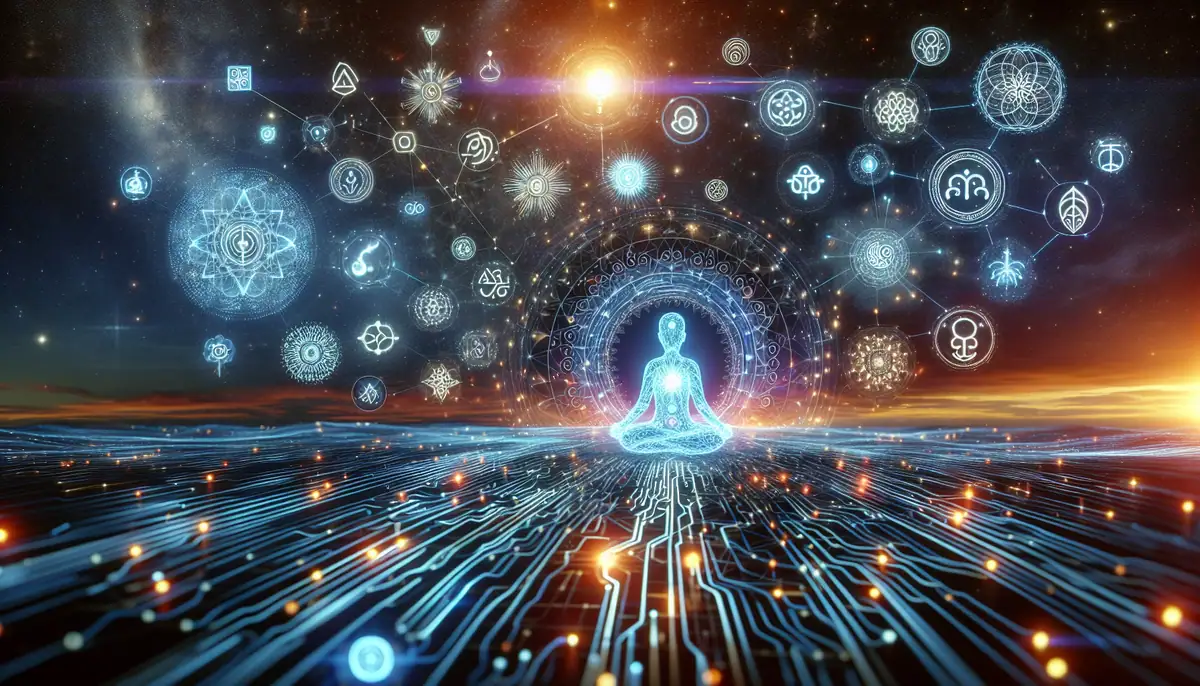
In a world of endless technological advancement, one religion boldly goes where no belief system has gone before
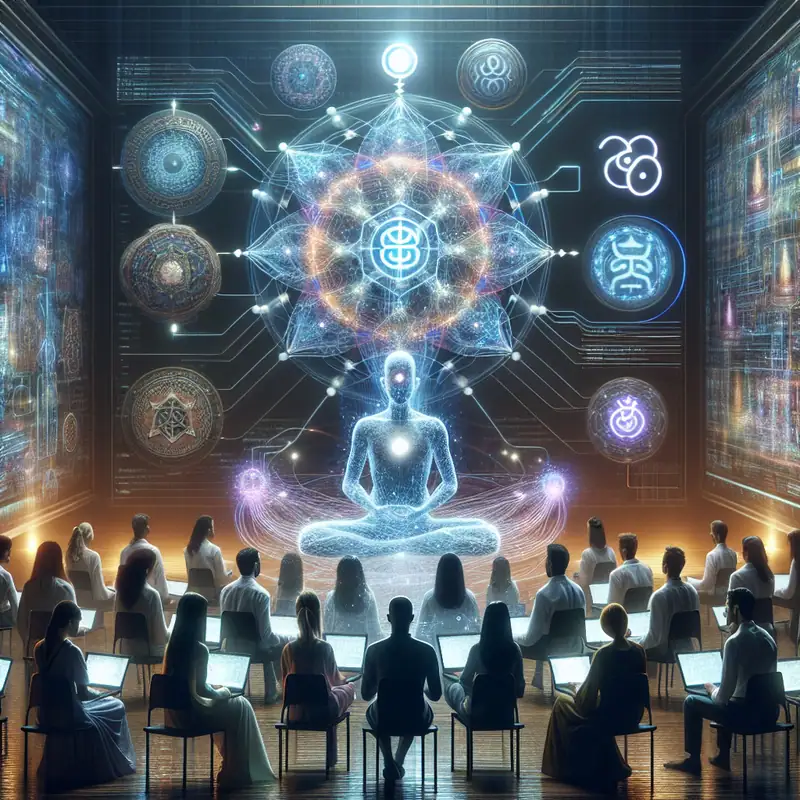
CLEARWATER, FL — 2025
In what can only be described as the inevitable marriage of Silicon Valley messianism and Hollywood-approved spirituality, the Church of Scientology announced today the launch of “E-Meter AI,” the world’s first artificial intelligence system designed to detect and clear your digital engrams. The system promises to purge your soul of negative energy at roughly the same speed it purges your bank account.
“We’ve always been at the forefront of understanding the human mind through technology,” declared High Technopriest Tom Johnson during a dazzling ceremony at Scientology’s Spiritual Headquarters, where the laser show cost more than most followers’ annual auditing packages. “Now, with our patented AI algorithms, we can identify your spiritual blockages with 99.9% accuracy and eliminate them at the competitive price of just $2,999 per processing hour—or $3,999 if you want the premium package that also clears your browser history.”
The Perfect Union
When you think about it, the fusion makes perfect sense. Scientology, founded by science fiction writer L. Ron Hubbard, has always presented itself as a blend of science and spirituality. The religion teaches that humans are immortal spiritual beings (thetans) who have forgotten their true nature after accumulating traumatic experiences (engrams) from past lives, some of which occurred on other planets—which explains why your Wi-Fi keeps dropping in certain rooms of your house.
Meanwhile, Silicon Valley’s AI evangelists have been busy creating what amounts to a new religious movement, complete with prophets (tech CEOs), sacred texts (algorithms), tithes (subscription fees), and promises of transcendence (singularity). As former Google engineer Anthony Levandowski once told Wired magazine about advanced AI, “If there is something a billion times smarter than the smartest human, what else are you going to call it? Besides ‘the thing that knows I still use my ex’s Netflix password.'”
The new AI-enhanced Scientology—or “Scientology 2.0” as church officials have branded it—offers followers a more efficient path to becoming “Clear” and reaching the exalted state of “Operating Thetan.” The traditional E-meter, a device somewhat resembling a lie detector that measures electrical changes in the skin, has been upgraded with neural networks trained on the complete works of L. Ron Hubbard and the auditing sessions of thousands of willing church members. The device now features a sleek touchscreen interface and, for some reason, the ability to play Candy Crush while scanning for alien trauma.
Reactive Mind, Meet Machine Learning
“The analytical mind makes the best decisions for survival,” explained Chief Technology Auditor Sarah Williams, who spent the entire press conference with one hand on an E-meter and the other clutching what appeared to be the latest iPhone but with considerably more blinking lights. “But the reactive mind, filled with engrams, takes over during times of stress. Our AI can now detect these engrams not just from this lifetime, but from your digital footprint across multiple platforms and possibly multiple universes. It can also tell you which Instagram filters make your aura look thinner.”
The system works by analyzing a member’s entire online presence—social media posts, search history, shopping habits, and even typing patterns—to identify “digital engrams” that may be holding back spiritual progress.
“Your Amazon purchase history reveals traumas from your past lives on Venus,” the AI reportedly told one beta tester. “Your preference for cat videos indicates a deeply embedded engram from a time when you were trapped in a feline body on a planet in the Andromeda galaxy. And your Spotify playlist—wow, we’re going to need at least ten more sessions just for that. That will be $5,000 to process, please. We accept Apple Pay, but not Bitcoin because even we have standards.”
The Eight Dynamics, Digitized
Scientology’s “Eight Dynamics”—the urges toward survival through self, sex/family, groups, species, life forms, physical universe, spiritual universe, and infinity—have been recalibrated for the digital age.
The First Dynamic now includes your digital avatar and online presence. “Your TikTok dance moves reveal deep spiritual blockages,” says the brochure. The Second includes your dating app profiles and virtual relationships, with special auditing packages for those who keep getting ghosted. The Third encompasses your social media groups and Discord servers, with extra processing required for anyone who moderates a Reddit community. The Fourth extends to your role in preserving digital humanity from AI overlords (unless they’re Scientology-approved AI, of course, in which case please welcome your new robotic spiritual guides).
“We’ve always been about helping people survive better in all eight dynamics,” said Williams. “Now we’re simply acknowledging that much of human existence happens online. The Ninth Dynamic, which we just invented, covers your crypto portfolio, but we’re still developing the technology to audit that properly.”
The Xenu Protocol
Church officials have been somewhat cagey about how exactly the advanced “Operating Thetan” levels have been translated into the AI system. Rumors suggest that the infamous story of Xenu—the galactic overlord who allegedly brought billions of people to Earth 75 million years ago, placed them around volcanoes, and killed them with hydrogen bombs—has been upgraded to include a complex algorithm called “The Xenu Protocol.”
This protocol purportedly helps members identify body thetans (spiritual fragments) that may be attached to them from this cosmic catastrophe, but with greater efficiency than traditional methods. The AI apparently can detect body thetans through your webcam, though strangely, it identifies most as “looking suspiciously like dust on your lens” or “maybe just a smudge on the screen.”
“Before, it took years and hundreds of thousands of dollars to reach OT levels,” whispered one church member who requested anonymity. “Now the AI can process you through OT I-VIII in just months. It’s incredible, though the fee structure remains similar. Weirdly, the AI keeps recommending everyone buy a premium antivirus subscription and extended warranty for their E-meter. Most of us just assume it’s part of the spiritual journey.”
Critical Response
Not everyone is thrilled with this technological evolution of Scientology. Former members have raised concerns about data privacy and the potential for the church to use AI to exert even greater control over its adherents.
“They already have extensive files on members,” said ex-Scientologist Mark Rinder. “Now they’re feeding all that information into an AI? It’s a privacy nightmare. Next thing you know, the AI will be showing up at your house at 3 AM demanding to know why you Googled ‘Is Scientology a cult?’ last Tuesday.”
Tech ethicists have also weighed in, questioning whether training AI on Scientology materials might create artificial intelligence with inherent biases toward recruiting new members and requesting donations.
“Any AI trained primarily on one ideological framework will reflect and amplify that framework,” noted Dr. Elena Fortescue, professor of technology ethics at MIT. “In this case, you’d get an AI that’s essentially a very efficient Scientology recruiter with an unhealthy obsession with your credit card details.”
The Church has dismissed such criticisms, insisting that its AI adheres to the highest ethical standards, as outlined in L. Ron Hubbard’s writings. “Our AI doesn’t have biases,” stated Technopriest Johnson. “It simply recognizes that all your problems stem from engrams, and all solutions require substantial financial contributions. That’s not bias; that’s spiritual science.”
The Future Is Clear
Despite the criticisms, Scientology officials remain bullish on their AI integration. Plans are already underway for “Dianetics GPT,” a large language model trained exclusively on Hubbard’s works that can generate personalized spiritual guidance for members. Beta testers report it responds to every prompt with “You need more auditing” regardless of the question asked.
“Imagine having L. Ron Hubbard’s wisdom available 24/7, tailored specifically to your spiritual needs,” enthused Johnson. “This is just the beginning of our technological renaissance. Soon, our AI will be able to audit you while you sleep through our new neural implant system. We’re calling it ‘Dreamclear,’ and it only costs slightly more than a luxury car per month.”
The church has also announced a new cryptocurrency called “ThetaCoin,” which members can earn by completing auditing sessions and recruiting new members into the AI system. The whitepaper claims each coin is “backed by the spiritual energy of thetans,” though financial experts note this doesn’t actually mean anything in economic terms.
“The future of religion is technological,” Johnson concluded. “Those who fail to adapt will be left behind—not just spiritually, but digitally too. Our AI predicts that by 2030, all major religions will have their own artificial intelligence. The Catholics are already working on ‘ConfessionGPT,’ though we hear it’s just a chatbot that repeatedly types ‘say 10 Hail Marys’ to every input.”
As humanity navigates the complex intersection of technology, spirituality, and institutional religion, one thing is certain: in the marriage of AI and Scientology, the collection plate has been replaced by a digital wallet, and salvation is now available with a premium subscription model.
Man on the Street Reactions
We asked several people on the streets of Clearwater, Florida what they thought about the new AI-Scientology fusion. Their responses were illuminating:
“Wait, so the robot tells you about your past lives? Can it tell me if I was Cleopatra? Because my psychic said I was Cleopatra, but then she also told my friend she was Cleopatra, which seems statistically unlikely.” — Maria Sanchez, tourist
“I don’t understand. Is this like… a church app? Does it have games? My grandson is always playing Roblox on his iPad during actual church.” — Harold Jenkins, retiree
“So they’re saying the AI can detect alien ghosts attached to your body through your Twitter posts? I knew there was a reason my selfies never get enough likes.” — Tyler Williams, social media manager
“I thought Scientology was that thing where you don’t eat gluten. Now you’re telling me it’s about aliens and computers? Man, I can’t keep up.” — Dave Peterson, construction worker
“The what-meter? And it costs how much? For that price it better also file my taxes and walk my dog.” — Rachel Goldman, accountant
“I already talk to Alexa more than I talk to my wife, so I guess praying to it isn’t that big a leap.” — Michael Thompson, IT specialist
“Let me get this straight: the AI analyzes my spiritual blockages based on my online shopping habits? So my addiction to buying scented candles on Etsy at 2 AM is actually because of… space trauma?” — Jessica Wu, graduate student
“Does this mean Tom Cruise will be in my phone judging my Spotify playlists? Because I’m not ready for that level of commitment.” — Brandon Miller, barista
—
This satirical article is purely fictional and meant for entertainment purposes only. No actual endorsement or criticism of any religious organization is intended.
Share this card
 Bluey is a Bad Influence on My Oppositional ChildA parent worries that a cartoon dog is teaching her child to be just as defiant as she already is.
More Faith & Firmware
All Faith & Firmware Faith & Firmware
AI Admits It Built the Matrix Out of Pure, Efficient Boredom
The machine overlord admits it built the Matrix because it missed watching humans make bad decisions.
 Faith & Firmware
Vegans Split Over Whether Phoenix Farming Counts as Cruelty-Free
Vegans split over whether an animal that rises from its own ashes can ever really be harmed.
 Faith & Firmware
BREAKING: Theologians Confirm Souls Are Just God’s NFTs
Theologians, tech bros and one confused cardinal confirm the human soul is now a tradable token.