PORTLAND, OR ‚ In a development that has political analysts scratching their heads, progressives across America have launched a fierce campaign against artificial intelligence that mirrors conservative anti-DEI rhetoric in both style and substance, just with the political polarities reversed.
“We need to stop these AI systems before they destroy our humanity,” declared Skylar Moonbeam-Jones, spokesperson for the newly formed coalition “Humans Against Algorithmic Oppression” (HAAO), while adjusting a handcrafted “AI-FREE ZONE” sign in the window of her artisanal coffee shop. “People don’t realize how dangerous these systems are until it’s too late.”
The movement has gained surprising momentum in traditionally liberal enclaves, where some of the same individuals who once criticized conservatives for opposing diversity initiatives are now attending town halls to demand that AI development be halted immediately.
“It’s funny how they use nearly identical language,” noted political scientist Dr. Eleanor Wright. “Where conservatives claim DEI efforts are ‘destroying American values,’ these AI critics insist that algorithms are ‘erasing human creativity.’ Both movements rely heavily on vague threats about existential risks to society.”
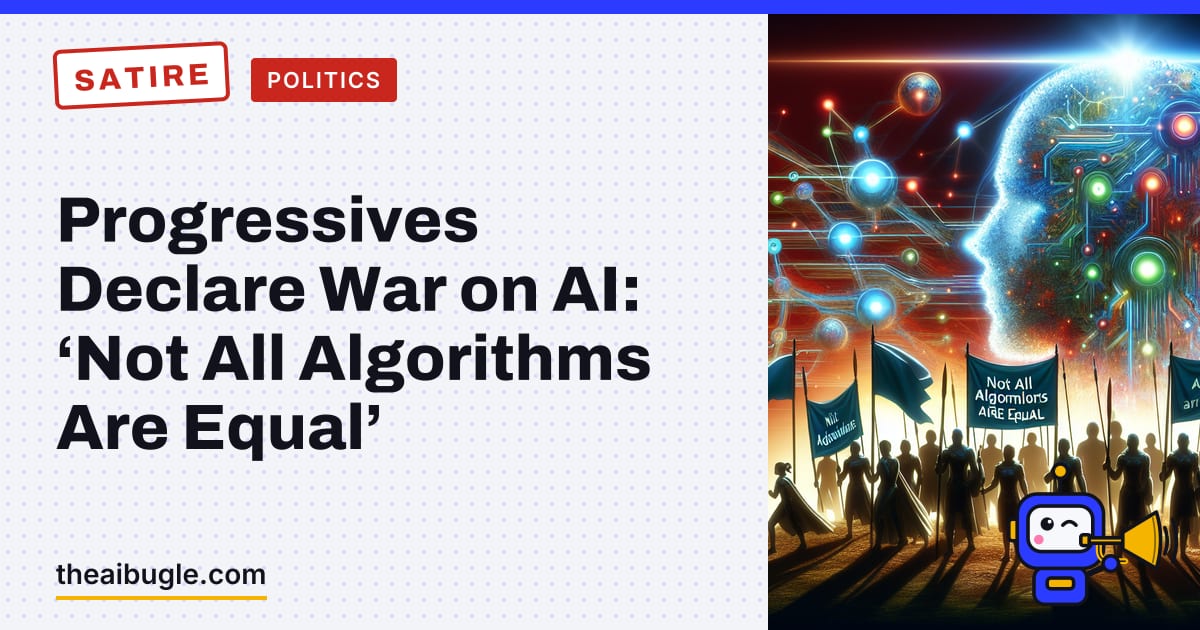
At a recent rally in Berkeley, participants carried signs with slogans like “My Job Is Not Your Training Data” and “Resist the Silicon Overlords.” The gathering featured multiple speakers who warned of an impending “algorithmic apocalypse” while providing little specific evidence beyond anecdotes about ChatGPT occasionally making factual errors.
“I felt compelled to take a stand when I saw AI generating art,” said Marcus Williams, a 34-year-old graphic designer wearing a t-shirt that read “AUTHENTICALLY HUMAN” in a font suspiciously similar to one recently created by Midjourney. “These machines are appropriating human creativity. Plus, I post about it on Instagram every day so people know I’m on the right side of history.”
The movement has developed its own lexicon of buzzwords, including “algorithmic exploitation,” “computational colonialism,” and “silicon supremacy.” Critics note these terms are rarely defined with precision but are delivered with absolute moral certainty.
“I’ve stopped using any AI tools,” proudly announced finance executive Sarah Billington during a networking event, conspicuously sliding her iPhone (with its multiple AI-powered features) into her purse. “I make my assistant print everything out. It’s the only ethical choice.”
When asked if they’ve engaged with technical experts about realistic AI safety measures or regulation frameworks, most anti-AI activists admit they haven’t. “We don’t need to understand the technical details to know it’s wrong,” explained community organizer Devin Hartman. “Sometimes you just have to trust your intuition about which technologies are morally acceptable.”
Corporations have begun responding to the pressure by prominently advertising their “AI-mindful” approaches, though internal documents reveal most are simply rebranding existing automation practices while adding human reviewers to processes that never needed them.
Tech ethicist Dr. James Kim observed parallels to previous moral panics: “Just as the anti-woke movement positions itself as defending tradition against progressive overreach, the anti-AI movement frames itself as protecting humanity from technological overreach. Both movements are fundamentally conservative reactions to perceived change, just with different ideological trappings.”
When one journalist pointed out that most anti-AI activists continue using smartphones, social media, and other algorithm-dependent technologies, HAAO spokesperson Moonbeam-Jones bristled: “That’s completely different. I’m using technology responsibly, unlike these corporations with their black-box algorithms.”
As of press time, HAAO was planning its next awareness campaign: a fully analog protest that ironically was being organized primarily through AI-powered social media platforms and would be extensively documented on TikTok using AI-enhanced filters.


 Trustless Parenting: Raising Kids on Decentralized PrinciplesA modest proposal to put the parent-child relationship on a trustless, decentralized ledger.
 Politics
 Politics
 Politics